
Financial Discipline vs. Financial Chaos: A Rivalry in Sport and in Management between Real Madrid and FC Barcelona
The Rivalry of the Ages
Does your family manage its money and assets as if it were a company? This is how Florentino Pérez manages Real Madrid: like a company. And this is how Barcelona should be managed, but it isn’t, as we will explore in this article. Even if you are not a football fan, the rivalry between FC Barcelona and Real Madrid is recognized worldwide. Since the foundation of the clubs, they have battled it out in LaLiga, the Champions League, and the Copa del Rey. The game between both clubs is so monumental that you can take the most recent Super Bowl’s viewership (~130 million) and multiply it by 5: the most recent El Clasico reached 650 million viewers! However, this rivalry extends beyond the pitch, and can also be seen in the clubs’ management.
Real Madrid, with their president Florentino Perez, and Barcelona, with their president Joan Laporta, have had a very similar approach to managing their club, with very different outcomes, and even though I am a Barça fan, I must admit that Madrid is better in terms of management. In this article we will be diving into how financial discipline can affect long-term success, and how these two clubs’ management decisions have aided or hindered their finances.
Real Madrid: Financial Discipline
Real Madrid is known for being footballing giants on the pitch, and formidable operators off it, combining their sporting dominance with exemplary financial management. In the 2023/2024 season, Real Madrid broke the record for being the first club to generate over $1 billion in revenue in a single season. This record-breaking revenue was mainly due to the newly renovated Bernabeu stadium, which accounted for a large portion of the club’s matchday and commercial revenue, says Deloitte.
Real Madrid was smart when deciding when to renovate their stadium. During Covid, clubs played games with empty stadiums while all the spectators were watching from home. Madrid took this opportunity to start renovating their stadium, which they had been planning to do for a while. They finished the renovation a couple of months after Covid ended and people were allowed back into the stadium. This stadium renovation spiked up matchday revenue up 11% year-on-year.
However, Madrid do not solely use their stadium for football purposes. Outside of football, Madrid host concerts and events at this massive stadium and make commissions on the use of their stadium. They have also partnered with many companies who have made high contributions to their revenue streams, which diversifies their revenue streams instead of concentrating their profits on football. Emirates Airlines, who have sponsored them and put their name on the front of each player’s jersey, contributes around $70 million per year; and Adidas have created the most valuable shirt sponsorship in the world, contributing to around $120 million per year for manufacturing their shirts. Real Madrid diversifies their cash flows, showing how they think ahead and stand out from their competition.
The following is a chart demonstrating Real Madrid’s exponential growth throughout the years since 2000 (given by Real Madrid):
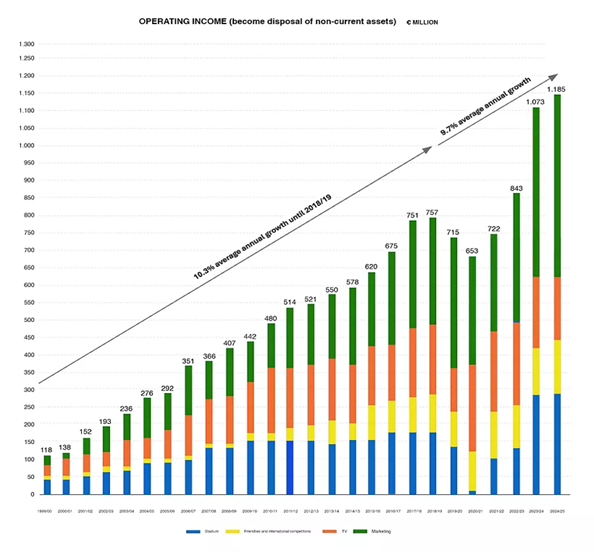
This shows that Real Madrid’s revenue spike is not just a one season wonder, they demonstrate longevity in their financial growth by increasing their profits by an average of €42.5 million each year.
FC Barcelona: Financial Chaos
Although Barcelona have been as dominant in the football world as Real Madrid, their financial and managerial success has shown to be very different. To start off, one of the main examples of Barcelona showcasing their poor management skills is through the transfer market. Barcelona has been drowning in debt ever since Neymar’s release clause was bought out by PSG for a record breaking €222 million. From then on, Barcelona went on a reckless spending spree as if they were kids at a candy store. Shortly after Neymar left, they went on to use that money to buy two rising stars, Ousmane Dembélé, from Borussia Dortmund for €148 million, and Philippe Coutinho, from Liverpool for around €160 million in total. The crazy part about this is that Dembele at the time was worth around €35 million, and Coutinho was worth around €90 million, meaning Barça overpaid over €100 million for both players. When Joan Laporta was elected president and returned to Barcelona in 2021, he was handed a club in a state of financial chaos due to poor management in previous years. Barcelona started swimming in debt when they could not manage their player wages, with their total debt racking up to around €1.35 billion when Laporta initially took control.
Thereafter, Barcelona wanted to renovate their stadium, like Real Madrid; however, they did it in a much more inefficient way. Firstly, they started the renovation shortly after the ideal period to start it, Covid, as was the case with Real Madrid. Consequentially, for the past 1.5 years, Barcelona has had to play in a much smaller stadium, generating much less revenue in seating than their original stadium: on average €2.8 million per home game at the Estadi Olimpic compared to €7 million at the Camp Nou, along with paying €20 million in rent for the Estadi Olimpic.
Barcelona played 19 games at the Estadi Olympic during the renovation: 2.8 million x 19 – 20 million = €33.2 million at the Estadi Olympic, compared to 7 x 19 = €133 million at the Camp Nou. That’s €100 million in lost revenue!
Additionally, the football club hired a construction company, Limak Construction, that has never had experience in stadium renovations. This partnership between Limak and Barcelona caused the club to face reputational damage, along with financial losses due to delays in the construction, which could have potentially cost them up to €300 million.
Even so, Barcelona recently started to bounce back to compensate for their financial errors, with their recent partnership with Spotify, that has shown itself to be very successful. The deal has made them $75 million per season, in addition to an increase in jersey sales due to their partnerships with massive artists, such as The Rolling Stones and Travis Scott. These partnerships between Barcelona and these artists with millions of fans created a bridge between the sporting world and the music world, where fans from each could discover and enjoy the other. Considering all of this, Barcelona’s debt has dipped in the past few years to around €470 million, compared to the €1.35 billion at its peak.
Conclusion
This rivalry between two footballing giants, Barcelona and Real Madrid, demonstrates that financial success is not obtained solely by luck, player quality, and global popularity, as both clubs rank about the same in these three categories. Instead, it is created by effectively managing risks, allocating resources, and how businesses, or clubs in this example, plan for their future. Ultimately, both teams are full of success and stir up passions, but one has our financial discipline, and the other should hire us. Here at Ockham Finance, we wish to help you learn how to manage your family’s money and assets like Real Madrid through our consulting meetings, and our articles.
Matías Neves - Ockham Finance Contributor
Sources:
· REAL MADRID CLOSES THE 2024/25 FINANCIAL YEAR WITH A NET PROFIT OF 24 MILLION EUROS
· Deloitte Football Money League 2025
· Where Barcelona Stands Financially Right Now | Heyvip.live
· FC Barcelona: A comprehensive overview of their financial crisis | BarcaFutbol
· Barcelona sees debt fall by 90 million after 'year of economic recovery' - Soccereco
